
Jim Beam encourages responsible drinking. Alcohol should be consumed in moderation. By entering this website, you are agreeing to our Terms and Conditions, Privacy Policy, and Cookie Policy.
*Must be legal drinking age to enter this site.
How to Celebrate Bourbon Heritage Month

September belongs to bourbon, and it has since 2007.
That was the year the Senate set aside the month to honor a spirit the country had already claimed as its own, along with the families who spent two centuries figuring out how to make it. Bourbon Heritage Month has been on the calendar ever since, arriving right as the weather starts to turn and everybody suddenly remembers they own a bottle of brown whiskey.
Most guides for the month read like a syllabus. Study the mash bill. Note the finish. Log your impressions. Nothing wrong with any of that, and there's a tasting flight further down this page for anyone who wants it. But bourbon never got made in a laboratory. It got made on farms, in cellars, in towns small enough that everybody knew whose still was whose, and it survived because somebody kept pouring it for somebody else. So treat the month accordingly. Learn a little, pour a lot, and make sure there's a second glass on the counter.
Nine Ways to Celebrate National Bourbon Heritage Month with Jim Beam
None of what follows takes expertise, and none of it takes much money. A couple of them will fill an afternoon, the rest take about as long as it does to fill a glass. Work down the list in order or pick the two that fit the September you've actually got.
Start With the Serve We Build Everything Around
If you only do one thing this month, make it this one.
Beam and Lemonade is the drink we hand people first, and there's no mystery to why. It's cold, citrus forward and lightly sweet, it takes under a minute, and it works just as well at a tailgate as it does on a porch in early September. Bourbon has spent decades being treated as something you earn. This is the version you just enjoy.
Here's the build, and the details matter more than they look:
- Fill the glass three quarters with ice. Sounds like a lot. It isn't. A properly iced glass stays cold longer, which keeps the drink sessionable instead of turning warm and heavy halfway down.
- Pour 1.5 oz of Jim Beam Original.
- Add three parts lemonade.
- Top with a splash of soda water. This is the step people skip and the one that does the work. It lifts the refreshment and cuts the sweetness so the drink stays easy through a long afternoon.
- Garnish with a lemon slice on the rim, and leave it there. Half the pleasure is watching a guest squeeze it in themselves.
Serve it in a 16 oz pint glass. Not a rocks glass, not a tumbler. The size is part of the point.
Make a pitcher, set it out with a bowl of ice and let people help themselves. You'll spend the evening with your guests instead of behind a counter, which is more or less the whole idea.
Run a Tasting Flight and Compare Mash Bills
Bourbon's personality comes mostly from its grain recipe, and the fastest way to understand that is to taste three of them side by side rather than read about it.
Pour a sweeter glass, where the corn can shine; a smoother one, with wheat; and another with enough rye to add a spicy kick and an intense finish. In small pours. First, neat, at room temperature, taking a moment to appreciate the aroma before tasting. Next, add a single ice cube or a few drops of water and taste again, because the second round is usually when things really come alive.
For real range across the three, our premium bourbon collection shows what extra years and different barrel work do to the same starting point.
Settle the Question of What Bourbon Even Is
Somebody at the table always asks. This is the time to have the answer ready.
Bourbon has to be made in the United States, from a grain mash of at least 51% corn, aged in new charred oak barrels, and bottled with nothing added but water. No coloring, no flavoring, no shortcuts. The rules are unusually strict for a spirit, and they're the reason a bottle of bourbon tastes like bourbon regardless of whose name is on the label.
Our guide to bourbon versus whiskey covers the rest, including the part where all bourbon is whiskey but the reverse falls apart fast.
Build a Classic the Slow Way
A handful of drinks carried bourbon through the last century, and bourbon month is the best business to build them properly instead of quickly.
The good ones are unforgiving in the same way. Sugar, bitters, citrus, ice, and nothing else invited to the party. Squeeze the lemon yourself. Stir it longer than feels necessary. Most of them punish anybody who reaches for one more ingredient, which is the whole appeal: there's nowhere to hide, so you either pay attention or you don't.
Our classic bourbon cocktails have the measures if you'd rather not eyeball it.
Bring Somebody New Into It
A month about heritage works better with somebody at the table who has none.
Everybody knows a person who says they don't like whiskey, usually on the strength of one bad night a decade ago. Arguing with them never works. Handing them something does. Pour over ice, add lemonade, cola or lemon lime soda, drop in a slice of whatever fruit matches, and hand it over without a speech attached.
Same formula every time: bourbon, mixer, ice and a slice. Our flavors range is built for exactly this moment, and it has converted more skeptics than any argument ever has.
Cook With the Bottle Before You Pour From It
Bourbon earns its keep in a skillet. A glaze reduced with brown sugar turns pork or salmon into the reason people showed up. A splash deepens barbecue sauce past what molasses manages alone. Bourbon pecan pie has been closing out American dinners for generations and has never once needed defending.
Cooking also stretches the celebration into a full evening rather than a nightcap, which is closer to the point of giving bourbon a month.
Find a Bourbon Festival Worth the Drive
September is the peak season for bourbon festivals, and Kentucky holds the heaviest concentration of them. Expect tastings, talks from people who spend their lives around barrels, cocktail competitions, live music, and a crowd unusually willing to explain their favorite pour to a stranger in line.
Beyond Kentucky, cities across the country run whiskey festivals and bourbon weeks through the fall, and bars and bottle shops schedule tastings all month long. Ask around. Somebody near you is pouring.
Go Stand Where It Started
If you can get to Kentucky, go. Our home in Clermont runs tours through the rackhouses year round, with Kentucky cooking and cocktails waiting at the end and the odd experience of standing on ground that has been making whiskey since 1795.
You come away with a sense of the scale of it that no article manages. Plan a bourbon distillery visit and see it in person.


Bourbon Heritage Month at Home? Here's How to Host Without Overthinking It
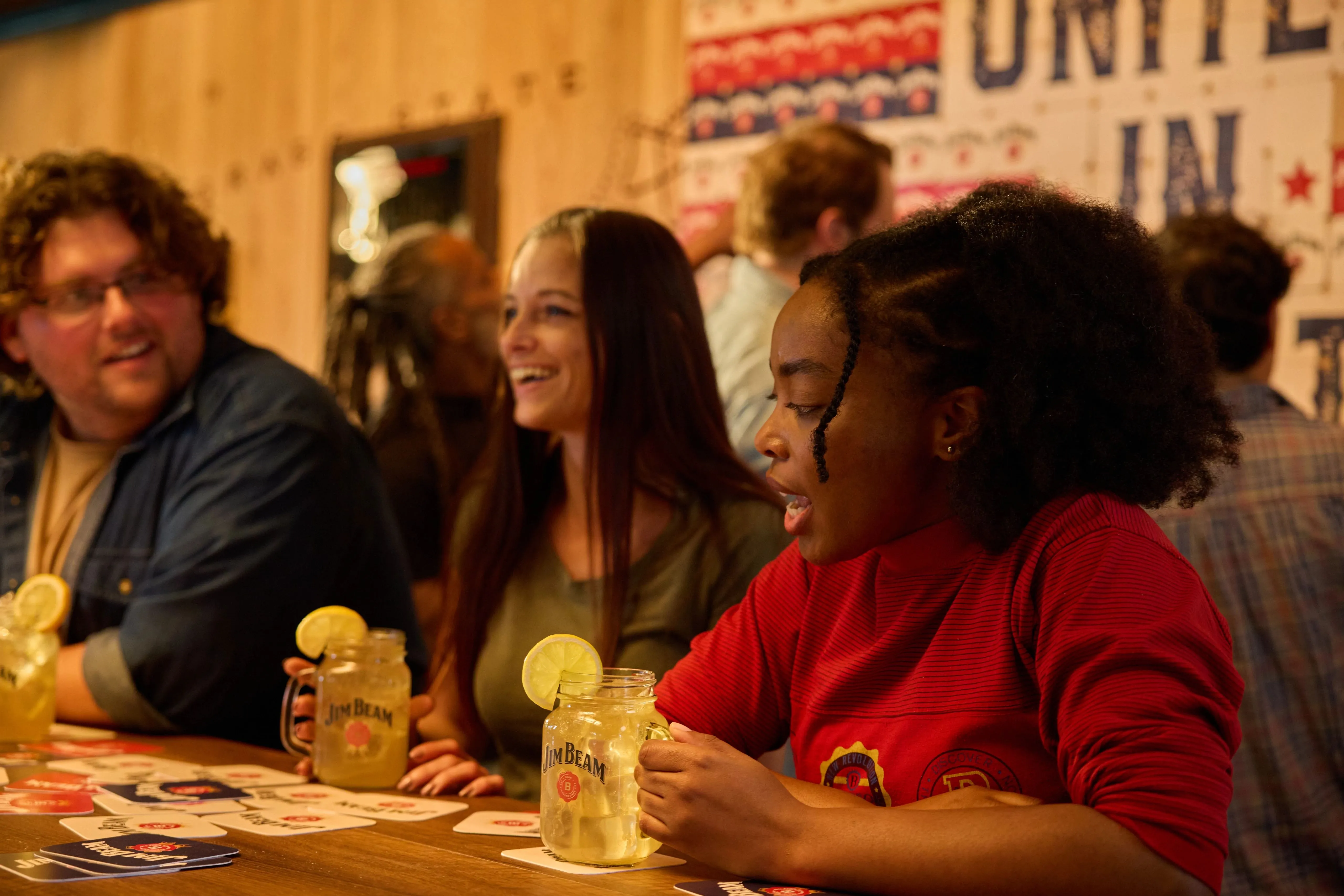
You need less than you think. Three bottles, a table with some room around it, and enough Jim Beam to keep things going once the tasting winds down.
- Pick three bottles that genuinely disagree with each other. One sweet and rounded, one soft, one with real spice. Three is the number: enough contrast to teach you something, few enough to keep the room sharp.
- Set the table like you mean it. A glass with a narrower rim for each pour, a pitcher of water, plain crackers, paper for notes. Nothing scented anywhere near it.
- Start neat and start slow. Room temperature, gentle on the nose, a small first sip held for a second before you swallow. Look for vanilla, caramel, oak and spice, and don't worry about being wrong.
- Add water or ice and go again. The bourbon opens up and half of what was hiding walks forward. This is the part people remember.
- Compare notes, then put the flight away. Pour everybody a Beam and Lemonade and let the evening turn into an evening. The tasting was the excuse, not the event.
Small pours, water on the table, food within reach, and no rush about any of it.

The Heritage Part Is a People Story
Bourbon history usually gets narrated through barrels and grain bills. Ours reads better as a family record.
Jacob Beam sold his first barrel of whiskey in 1795. Eight generations later his descendants are still working in Clermont, Kentucky, which is a genuinely strange sentence when you sit with it. Eight generations. Through the Civil War, through Prohibition, through every plausible reason to quit and do something easier. Somebody kept handing the recipe forward, and somebody on the other end kept taking it.
That handover is the thing worth raising a glass to in September. Not the bottle behind glass in a museum case. The stubborn, unglamorous business of one person trusting the next with something they care about.
Eight generations of it, the Beam family history lays it out barrel by barrel.
Make September Count
There's no correct way to do Bourbon Heritage Month, which is a relief. Learn something about how the stuff gets made. Build a classic with some care. Set out a pitcher and let people help themselves. Get to a festival or get to Clermont.
Just don't spend the month admiring bourbon by yourself. Eight generations of one family didn't keep this going so it could be studied privately. They kept it going because there was always somebody else worth pouring for.
Pull up a chair. There's room.
Frequently Asked Questions about the Bourbon Month
Bourbon Heritage Month is an American observance held every September that recognizes bourbon as America's Native Spirit and honors the families, distillers, farmers and coopers who built the category. It was created by Senate Resolution 294, agreed to on August 2, 2007 by unanimous consent, and it exists to mark bourbon's place in the history of the United States rather than to promote any particular brand. The resolution leans heavily on the idea of heritage and tradition, which is why the month tends to be spent on tastings, distillery visits and festivals rather than on discounts.
It was introduced by Senator Jim Bunning of Kentucky and passed the Senate without objection in the summer of 2007. Here's the part almost nobody mentions: the resolution designated September 2007 specifically, so strictly speaking it covered a single year and would need re-passing to carry official weight annually. It never really mattered. Distillers, bars and drinkers simply kept observing it, and September has belonged to bourbon by custom ever since. September 2026 marks the twentieth.
Not in those words, and this one surprises people. On May 4, 1964, Congress passed a concurrent resolution recognizing bourbon whiskey as a distinctive product of the United States, unlike any other spirit foreign or domestic. That's the language that protects the word bourbon on a label to this day. The phrase "America's Native Spirit" actually arrived 43 years later, in the 2007 resolution that created Bourbon Heritage Month. Both are real. They just came from different decades.
The observance is national, and bourbon can legally be made anywhere in the United States. That said, the resolution is unmistakably a Kentucky document, written around the state's farming communities, its distilling families and the visitors who arrive every September. The overwhelming majority of the world's bourbon is still made in Kentucky, which is why the month feels like a Kentucky occasion even though it belongs to the whole country.