
Jim Beam engagiert sich für einen verantwortungsbewussten Umgang mit Alkohol. Alkohol sollte immer nur in Moderation konsumiert werden. Durch den Besuch dieser Website stimmen Sie unseren Allgemeinen Geschäftsbedingungen, unserer Datenschutzrichtlinie und unserer Cookie-Richtlinie zu.
*Um diese Website zu betreten, müssen Sie das gesetzliche Mindestalter für den Alkoholkonsum erreicht haben.
Folgen Sie möglichst den DRINKSMART® Empfehlungen für verantwortungsvollen Konsum.
Unterschied zwischen
Bourbon und Whisky

Bourbon ist eine Art von Whiskey, aber nicht jeder Whiskey ist ein Bourbon
Es gibt viele Arten von Whiskey (oder „Whisky“, je nachdem, woher Sie kommen). Wie zum Beispiel Scotch Whisky, Irish Whiskey, Tennessee Whiskey, Rye Whiskey, Bourbon Whiskey und natürlich Kentucky Straight Bourbon Whiskey. Bei Jim Beam sind wir ziemlich angetan von den letzten beiden und möchten dir erklären, was Bourbon von den anderen unterscheidet.

Letztendlich läuft alles auf eine Reihe ziemlich
hoher Standards hinaus, die
von der Regierung festgelegt wurden. Sie entscheiden,
was was ist.
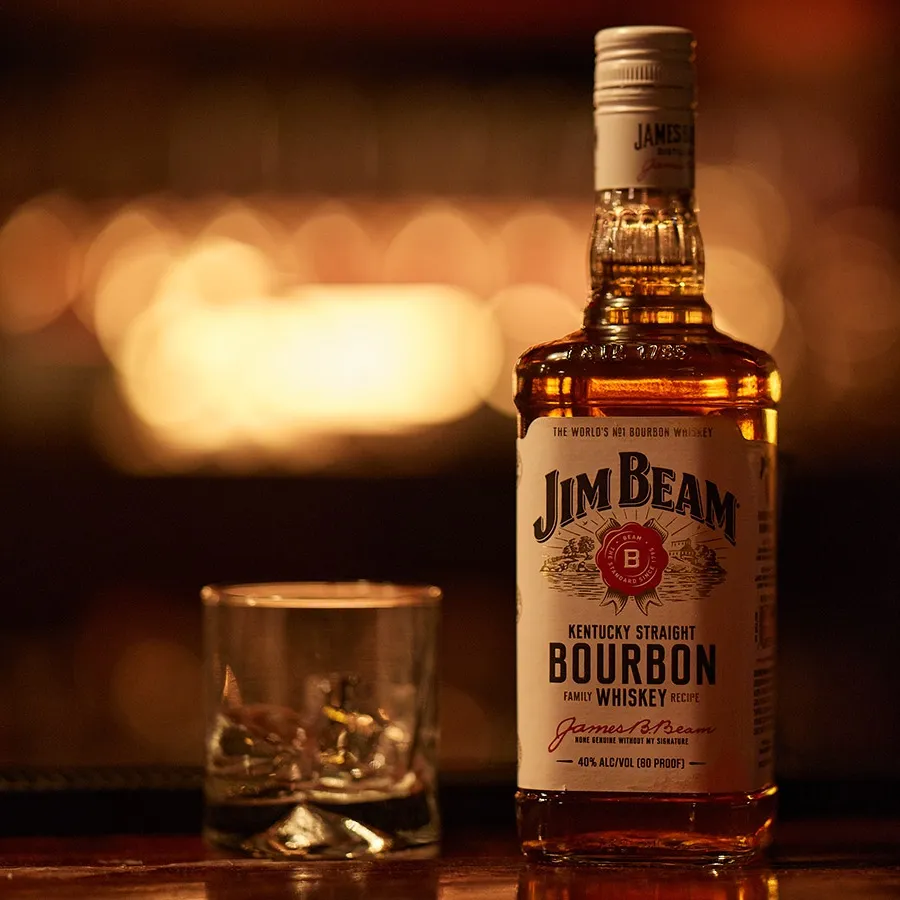
Aber wir können dir Folgendes sagen: Man muss alle unten genannten Kriterien erfüllen, um als Bourbon bezeichnet werden zu können. Und Jim Beam erfüllt diese Kriterien nicht nur, er ist der weltweit führende Bourbon.
- Hergestellt in den Vereinigten Staaten von Amerika (nicht Kentucky)
- Produkt aus einer fermentierten Maische mit 51 % Maisanteil.
- Destilliert bei maximal 160 Proof
- In neuen, verkohlten Eichenfässern bei maximal 125 Proof gelagert.
- Mindestens zwei Jahre gereift.
- Frei von Zusatzstoffen.
This Is What Makes It Bourbon
Why corn matters
When European settlers arrived in America, they brought their grains with them. Barley had its place. Rye had its place. But in Kentucky, in the late 1700s, corn grew abundantly and reliably. For early Kentucky distillers, including the Beams, corn was not just available. It made something different.
The flavor difference: Bourbon vs Whiskey
One of the clearest taste differences between bourbon and whiskey from other traditions comes from the barrel. Bourbon must age in virgin American oak barrels, where the wood helps shape the color, smoothness and flavor that make bourbon so easy to enjoy.
It helps give bourbon its deeper color and its smooth, mellow flavor, with notes of vanilla, caramel and oak. That flavor is not added. It comes from the grain, the wood, and the time they spend together.
The proof rules help protect that character, too. Bourbon is distilled at no more than 160 proof (80% ABV), entered into the barrel at no more than 125 proof (62.5% ABV), and bottled at no less than 80 proof (40% ABV). By the time it reaches the bottle, only water can be added to bring it to proof. Nothing else.
And when we’re done with those barrels, other whiskeys, wines and beers have been known to use them, hoping to pick up some of that bourbon character left in the wood.
We take that as a compliment.
Four Years in Oak. No Additives.
The law says two years for Straight Bourbon. We’ve always treated that as a starting point, not a finish line. Jim Beam Kentucky Straight Bourbon Whiskey is aged for a minimum of four years because those extra seasons matter.
Kentucky’s climate does a lot of work. Warm summers push the bourbon into the wood. Cooler winters draw it back out. Season after season, that movement helps build color, smoothness and flavor. It is not about making bourbon sound more complicated than it is. It is about letting oak and time do what they do best.
And when the bourbon comes out of the barrel, nothing goes in except water to bring it to proof. No added flavoring. No added coloring. No neutral spirits.
Four years in fresh American oak gives Jim Beam its character. We’ve never felt the need to dress it up.


Common bourbon myths worth busting
Bourbon has rules. A lot of them. And honestly, we don’t mind — we’ve been following them longer than most people have been asking about them. But over the years, a few myths have stuck around that blur what bourbon actually is.
So let’s clear them up.
Kentucky has a monopoly on Bourbon
You’ve probably heard that bourbon must come from Kentucky. It sounds true, but it isn’t. Bourbon can legally be made anywhere in the United States of America.
That said, Kentucky has earned its place in bourbon history. The climate, the limestone-filtered water and the generations of craft passed down there all help shape the way bourbon matures and tastes. Those things are not legal requirements, but they do make a difference.
That is why Jim Beam makes its bourbon in Clermont, Kentucky. Not because Kentucky is the only place bourbon can be made, but because it is the place we know best. The map alone does not make a whiskey bourbon. What happens in the mash, the barrel and the bottle does.
Every Bourbon Spends Two Years in the Barrel
The law does not demand two years for every bourbon. That two-year mark applies to Straight Bourbon.
But time matters. It deepens the color, rounds out the flavor and brings those notes of vanilla, caramel and oak forward from the charred barrel. The law sets one standard. At Jim Beam, we give our bourbon more time.
Jim Beam Kentucky Straight Bourbon Whiskey is aged for a minimum of four years in newly charred American oak barrels. We do it because those extra seasons matter, and because the barrel has always been one of our best partners.
All Bourbon Goes Through the Same Filter
It doesn’t. Bourbon law doesn’t require one specific filtration method, so each maker has to decide how to handle that final step before bottling.
Some producers filter more heavily. Others keep it lighter. At Jim Beam, the goal is simple: keep the bourbon clear and consistent while protecting the flavor the barrel worked so hard to build.
That final touch matters. By the time bourbon reaches the bottle, the corn, oak, char and time have already done the heavy lifting. Our job is to protect the character the barrel worked so hard to build.


Da sie zu mindestens 51 % aus Mais bestehen, haben alle Bourbons eine angenehme Süße.


Diese Art der Fassbehandlung, im Gegensatz zu gerösteten oder gebrauchten Fässern, verleiht einen reicheren Geschmack und eine tiefere Farbe. Jim Beam wird in neuen Fässern aus amerikanischer Weißeiche mit Ausflammungsgrad 4 gereift, für einen samtigen, geschmeidigen Geschmack mit Geschmacksnoten von Vanille und Karamell. Wenn wir diese Fässer nicht mehr benötigen, werden sie für verschiedene andere Whiskey- und Scotch-Sorten, Weine und sogar Biere wiederverwendet, in der Hoffnung, einige der tiefen und komplexen Bourbon-Geschmacksnoten, die im Holz eingeschlossen sind, "auszuleihen.
Nach US-amerikanischem Recht muss Bourbon mindestens zwei Jahre gelagert werden. Aber auch andere Faktoren wie extreme Temperaturschwankungen zwischen den Jahreszeiten beeinflussen, wie Whiskey reift. Ein in Kentucky gereifter Whiskey reift viel schneller als einer, der in Schottland gereift ist. Hier bei Jim Beam lassen wir unseren Bourbon mindestens vier Jahre reifen, um einen reiferen, extra-milden Geschmack zu erzielen. Das Einschenken ist das Warten wert.


Viele Whiskey-Hersteller fügen ihren Whiskeys Aromastoffe oder Karamellfarbe hinzu. Aber selbst wenn sie alle anderen Bourbon-Regeln einhalten, dürfen sie ihren Whiskey nicht „Bourbon“ nennen. Das Einzige, was dem Bourbon hinzugefügt werden darf, ist Wasser (und das nur, um den Alkoholgehalt zu reduzieren).
UNSERE BOURBONS
Wirf einen Blick auf unser Sortiment, schau was dich anspricht und erfahre die Geschichte hinter jedem einzelnen von ihnen.
EVENTS
Entdecke die Musik-Events rund um Jim Beam
